Silvra — Digital infrastructure from Europe
01Communication
Silvra Messenger
Chats end-to-end encrypted — with post-quantum key exchange from the very first handshake.
Explore the messenger02Infrastructure
Helix Blockchain
A layer-1 blockchain whose signatures are post-quantum secure throughout — from the very first block.
Explore Helix
00Silvra
Encrypted. Sovereign. European.
We build digital infrastructure Europe can still trust decades from now.
Communication and blockchain with post-quantum cryptography where it counts: in key exchange and in signatures. Developed in the EU — no ads, no selling of data.
- End-to-end encrypted chats
- Post-quantum key exchange
- Helix: open source (MIT)
- Transparency over promises
- Signatures per FIPS 204
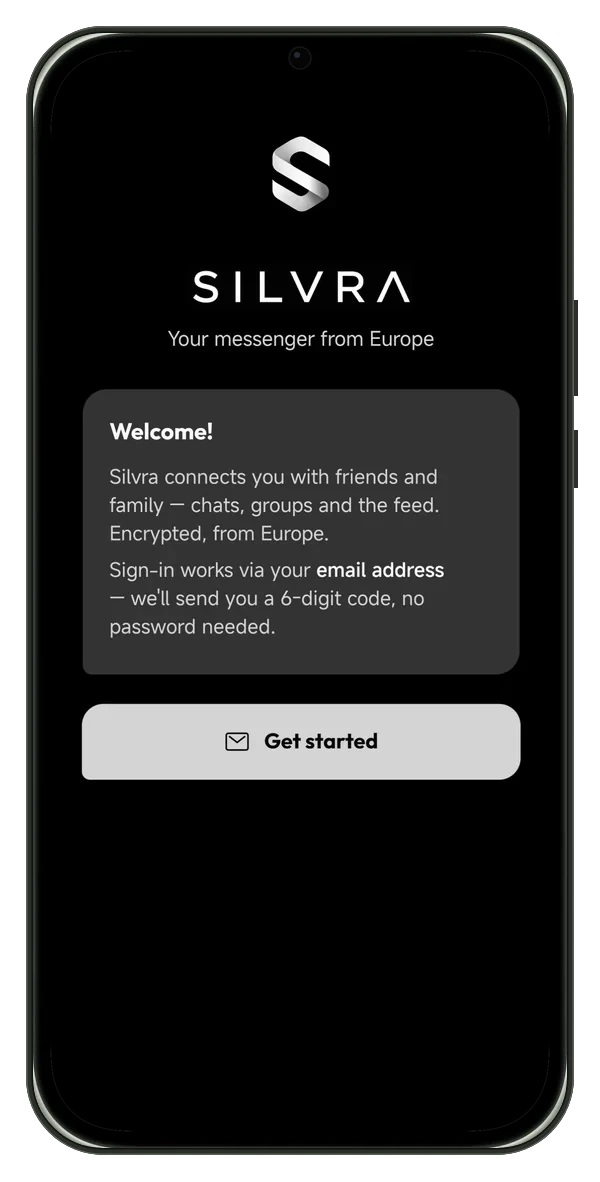
Silvra Messenger
End-to-end encrypted with MLS and X-Wing. No phone number, no ads.
 Helix · Mainnet live
Block height, just now
—
Active validators: — · ≈ 2 s per block · ML-DSA-65 on every signature
- FIPS 203ML-KEM · key exchange
- FIPS 204ML-DSA · signatures
- FIPS 205SLH-DSA · backup signatures
- RFC 9420MLS · group encryption
0
- Ads
- Tracking
- Selling data
- Cookies on this website
Helix is MIT-licensed.
Source, releases and documentation — open on GitHub.
(opens in a new tab)01Foundation
Two products. One foundation.
Both answer the same question: what does digital infrastructure look like that can still be trusted twenty years from now?
02Situation
Encryption with an expiry date.
Much of the encryption that carries today’s internet rests on mathematical problems that a sufficiently large quantum computer can solve.
Today
Intercept and store
Encrypted data is intercepted and kept. It is unreadable today — it is stored anyway.
Some day
The quantum computer
A sufficiently large quantum computer breaks the classical schemes. Nobody knows when that will be.
With Silvra
Prepared from the start
Where we have the choice, we use the schemes NIST standardised in 2024. Where we do not, the inventory below lists it.
03Inventory
Every building block, with its standard and status.
The cryptography in the messenger and in Helix, listed in full — including where it is still classical. Everything here comes from the projects’ code and documentation.
- 4 Post-quantum
- 3 Symmetric/hash, 256-bit
- 3 Classical
- 1 Not end-to-end
| Building block | Method | Standard | Against quantum computers |
|---|---|---|---|
| Silvra Messenger | |||
| Key exchangeHybrid: if one scheme breaks, the other holds. | X-Wing (X25519 + ML-KEM-768) in MLS | FIPS 203 · RFC 9420 · X-Wing (IETF draft) | Post-quantum |
| Message contentGrover’s algorithm halves the effective key length from 256 to 128 bits — still enough. | ChaCha20-Poly1305 | RFC 8439 | Symmetric/hash, 256-bit |
| AttachmentsThe file key travels inside the encrypted MLS message. | AES-256-GCM, one key per file | FIPS 197 · SP 800-38D | Symmetric/hash, 256-bit |
| Sender signaturesConcerns authenticity, not the confidentiality of stored messages. | Ed25519 (in MLS) | RFC 8032 | Classical |
| Voice and video callsEncrypted, but with classical schemes. | WebRTC, DTLS-SRTP | RFC 5764 | Classical |
| Updates feedA broadcast to contacts; posts are stored in plain text on the server. | — | — | Not end-to-end |
| Helix | |||
| SignaturesEvery transaction, every block, every validator vote. | ML-DSA-65 | FIPS 204 | Post-quantum |
| Backup signaturesHash-based — rests on different mathematics than ML-DSA. | SLH-DSA-SHA2-192s | FIPS 205 | Post-quantum |
| Hashing256-bit output: Grover lowers preimage security to about 128 bits — still enough. | BLAKE3 | — | Symmetric/hash, 256-bit |
| Zero-knowledge proofsHash-based, no elliptic curves. | ZK-STARKs | — | Post-quantum |
| P2P transportCarries only public, ML-DSA-signed data: readable, but not forgeable. | libp2p Noise (X25519) | — | Classical |
Sources:Helix 1.1.0 · docs/internals.md (opens in a new tab)Messenger: team statement (source not public)As of October 2026
04Principles
Thorough, not loud.
- 01
Two things, done properly
A messenger and a blockchain — nothing more. Both thought through down to their cryptography.
- 02
Live when ready
New features ship once they are tested — not on an announced date.
- 03
Open about gaps
Classical building blocks are listed in the inventory next to the post-quantum ones — not in a footnote.
05Europe
From Europe. For Europe.
We want there to be European alternatives. Not as a label, but as software people can actually use.
Developed in the EU
Silvra works from the EU and is subject to European law, including the GDPR. That is a decision about jurisdiction.
No selling of data
No business model built on reselling usage data. No ad space either.
Verifiable
Helix is open source (MIT) and anyone can check it. The messenger’s source is not public at the moment; our servers cannot read the content of your chats.
06Live status
Helix is running. Right now.
The mainnet, live: a block roughly every two seconds, read straight from the public node — no simulation.
More about Helix- Validators
- —
- Accounts
- —
- Issued
- —
- Burned
- —
- Peers
- —
- Version
- —
07Questions
Frequently asked questions
Answered briefly. And if something is missing: write to us.
Ask your own questionWhat does “post-quantum secure” mean?
Schemes that, as far as anyone knows today, even a large quantum computer cannot break. Silvra uses the schemes the US standards institute NIST standardised in 2024: ML-KEM (FIPS 203) for the messenger’s key exchange and ML-DSA (FIPS 204) for signatures on Helix.
Can Silvra read my messages?
No. Chats are end-to-end encrypted, and the keys live only on your devices. Two things are protected differently: posts in the Updates feed are stored in plain text on the server, and calls use classical rather than post-quantum encryption.
What does Silvra Messenger cost?
Nothing. It is free on Google Play — with no ads and no business model built on your data.
Is Silvra Messenger available for iOS?
Not at the moment. The messenger is available for Android only, through Google Play.
Do I need a phone number?
No. You sign in with your email address and a six-digit code — no password.
Where is Silvra developed?
In the EU. This website is served through GitHub Pages and the public Helix node node.silvra.net through Cloudflare; details are in the privacy policy.
Is Silvra a government body?
No. Silvra is an independent project — not a public authority, acting on no government mandate and with no connection to any armed forces or authority.
Is HLX an investment?
No. Helix has run as a mainnet since version 1.0.0 and is no longer reset — which does not mean HLX is worth anything. We do not promise it is.
Is Silvra open source?
Helix is: its code is MIT-licensed on GitHub. The messenger is not public at the moment.
08Get involved
Help build Europe’s digital future.
Whether you want to contribute, run a validator or simply know what we are working on — write to us.